


Adventure Tourism - the Price Paid
Last June, two friends and I climbed Mount Kilimanjaro. The idea came on a whim — a few group chat texts along the lines of “how’s about hiking to the highest place in Africa?” and I was sold. Superlatives are made of gold, after all.
The climb took six days and covered 70 kilometers to a height of 5,895 meters. We walked through rainforest and moorland, into a barren alpine desert where only ravens kept us company. On the summit day, we set out at dawn, spending seven hours trudging slowly uphill in the frigid dark. Altitude sickness had me fighting nausea and a desire to vomit with every step. Left foot. Right foot. Eventually - somehow - we made it. At the top, the weather was clear, the icy ground a shimmering blinding white as it scattered the sun. It was beautiful.
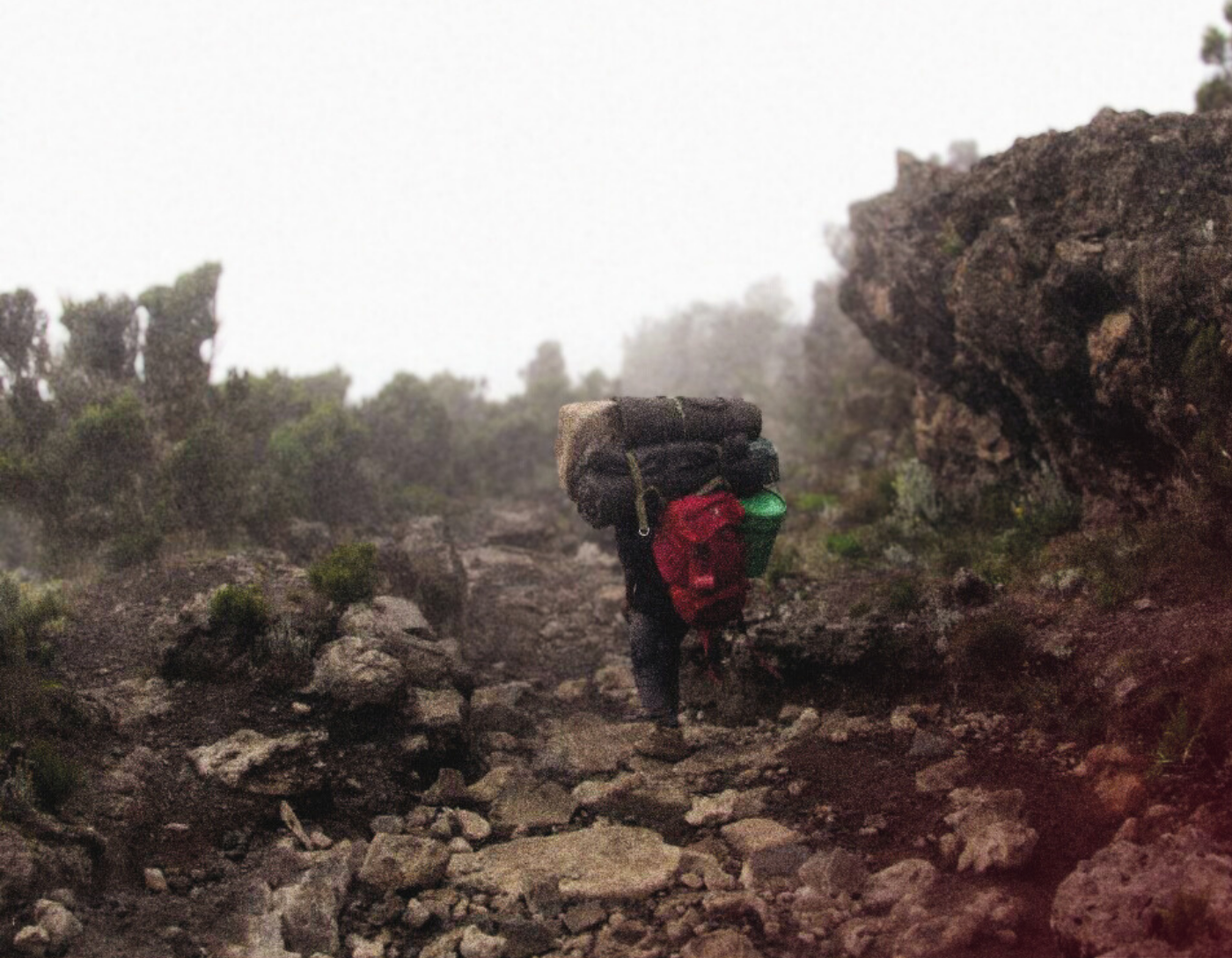
That’s my story; but it isn’t the story. Because we weren’t alone. With us were sixteen porters and two guides — eighteen people who made the climb possible.
It would be easier to list what the porters didn’t do. They carried our bags, food, tents, and cooking gear. They cooked hot meals and fetched clean water. They woke before us, raced ahead to set up camp, and slept after us. They did this while hauling their own gear, and while battling the same altitude sickness that had me breaking. Of the sixteen who started with us, only thirteen reached base camp; the others had to descend, too sick to continue. Unlike the Sherpa people of Everest, Kilimanjaro’s porters are not high-altitude dwellers, just local village people living near sea-level. To them, every climb is the same battle against their body and acclimatization made anew.
I talked to a former porter, now a guide, Nechi Kessy1. He began portering on the mountain at age 19, hoping to pay his way through college. As he explains his experience starting out:
“Carrying heavy loads day after day at high altitude was extremely challenging. I still remember my very first climb, when I had to face the Barranco Wall about 250 meters high. Halfway up, I broke down in tears, completely exhausted and ready to give up.”
Porters also play a role in climbing safety. On the summit night, a porter followed us with a flask of ginger tea. His real role wasn’t hospitality, but insurance: an extra body in case someone had to be carried down.
For this, porters earn $5–8 a day. The official minimum is $20, but in practice rules are “guidelines”. Kessy notes:
“Some companies exploit their workers by paying extremely low wages, sometimes as little as $5 per day instead of giving fair pay for the hard work and risk involved. This system of underpayment and mismanagement makes it very difficult for porters and guides to earn a decent living.”
Deaths are not uncommon on Kilimanjaro, though figures are hidden. Estimates suggest three to twenty porters die each year2, often from exposure made lethal by altitude delirium, and poor equipment. Bodies wear out quickly under such work; many porters retire before forty. Kessy continues:
“Companies play a huge role in the quality of working conditions for porters and guides. Some companies provide proper equipment, fair workload distribution, and enforce safety measures, while others neglect these standards.”
The low wages are padded with tips — but this does not always materialize:
“Many porters do not speak English well, so they rely on guides to communicate with clients. In some cases, guides may take a portion of the tips that clients give, leaving porters with much less than they earned.”
And even if they did — what is fair remuneration for this kind of labor? For work you know is destructive to the health of others, but which they are compelled to for lack of alternatives? The value of my European currency — inflated through decades of exploitative trade relationships with countries in the Global South — effectively allows me to purchase the bodies of humans for cheaper than you could imagine. Does this privilege come with responsibility?
To most, the answer is no. Climbers usually never see Tanzania beyond the airport, the mountain, and perhaps Zanzibar. The labor that makes their summit possible is underpaid and forgotten. And truly who can blame them? The effort of conditioning and getting oneself equipped for the climb likely eats up most of the spare mental capital people have. It’s hard to expect them to do a thesis level deep-dive to research the conditions of each company serving the mountain.
I don’t have a neat takeaway here. I did climb the mountain, and in doing so, I exploited inequities that allowed me to afford it. I risked the health of others for a short summer adventure. Should I feel guilty about that? I’m not sure. At the end of the day, for the otherwise subsistence farming locals this is their best source of income. My choice carries neither a curse nor salvation, just the continuation of the status quo.
And while we wrestle with that question, the mountain itself is disappearing. Kilimanjaro’s glacier has lost 80% of its ice in the past century and may be gone entirely by the 2040s3. So hey, if you ever wanted to go see one of the most beautiful sights this green Earth has to offer, now might be the time to do it. Perhaps that is the most apt metaphor of all — the mountain, just like the people who serve and live off it, may just be an ephemeral existence to be used and discarded.


